
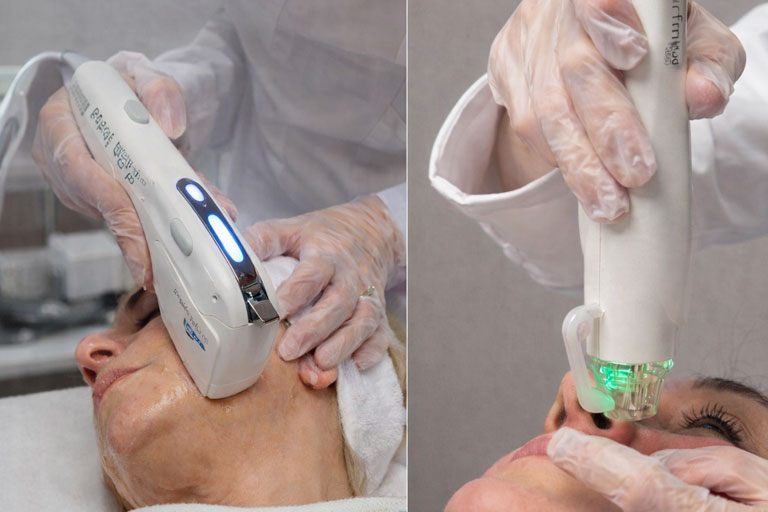
As non-invasive aesthetic technologies continue to advance, HIFU (High-Intensity Focused Ultrasound) and RF Microneedling (Radiofrequency Microneedling) have become two of the most effective treatments for skin tightening and rejuvenation.
While both stimulate collagen and improve skin firmness, they work at different depths and mechanisms, making each suitable for specific concerns.
This guide breaks down the real differences between HIFU and RF Microneedling so you can choose the right treatment based on your skin goals.
What Is HIFU Skin Tightening?
HIFU uses focused ultrasound energy to penetrate deep into the skin, targeting the SMAS layer—the same structural layer addressed in surgical facelifts.
How It Works:
- Delivers ultrasound energy at depths of 1.5mm, 3.0mm, and 4.5mm
- Triggers deep collagen regeneration
- Bypasses the skin surface (non-invasive, no needles)
Best For:
- Lifting sagging skin (jawline, neck, brows)
- Non-surgical facelift effect
- Deep structural tightening
What Is RF Microneedling?
RF Microneedling combines microneedling with radiofrequency energy to treat both the surface and deeper dermis.
Unlike HIFU, it delivers controlled heat through micro-needles, creating both mechanical and thermal stimulation.
How It Works:
- Tiny needles penetrate the skin (adjustable depth)
- RF energy is delivered inside the dermis
- Stimulates collagen, elastin, and tissue remodeling
Best For:
- Acne scars (especially depressed scars)
- Skin texture and enlarged pores
- Fine lines and mild-to-moderate laxity
- Skin tightening with surface refinement
Key Differences: HIFU vs RF Microneedling
| Feature | HIFU | RF Microneedling |
|---|---|---|
| Technology | Focused Ultrasound | Microneedles + RF Energy |
| Depth | Up to 4.5mm (SMAS layer) | Epidermis + Dermis (multi-depth) |
| Main Effect | Lifting & contouring | Texture + tightening + scar remodeling |
| Best For | Sagging skin | Acne scars + skin quality |
| Pain Level | Moderate (sharp pulses) | Mild to moderate (with numbing) |
| Downtime | None | 24–48h redness |
| Sessions | 1–2 per year | 3–4 sessions |
| Results | Gradual lift (2–3 months) | Progressive improvement (weeks) |
Which One Is Right for You?
Choose HIFU if:
- You want lifting and contouring
- Your concern is sagging (jawline, double chin, neck)
- You prefer fewer sessions
Choose RF Microneedling if:
- You want skin improvement + tightening together
- You have acne scars or uneven texture
- You want visible skin quality improvement (pores, tone, smoothness)
Can You Combine HIFU and RF Microneedling?
Yes—and this is often the best clinical approach.
- HIFU → targets deep structural lifting
- RF Microneedling → improves surface + dermal quality
Together, they provide:
- Deep lift + surface refinement
- Better collagen stimulation across all layers
- More complete facial rejuvenation
Safety and Suitability
Both treatments are:
- Non-surgical
- Safe for most skin types
- Minimal risk when performed professionally
However, RF Microneedling is often:
- Safer for darker skin tones
- More versatile for treating multiple concerns simultaneously
Final Thoughts: HIFU vs RF Microneedling
HIFU and RF Microneedling are not competitors—they are complementary technologies.
- HIFU = Lift (deep layers)
- RF Microneedling = Repair + Refine (surface + dermis)
If your goal is:
- Lifting only → HIFU
- Skin quality + scars → RF Microneedling
- Full rejuvenation → Combine both
For optimal results, a customized treatment plan based on your skin condition and goals is essential.